
The Essential Rental Property Expenses Checklist for Investors
Don't lose money on your next deal. Our comprehensive guide to rental property expenses covers everything from tax to capex to ensure accurate underwriting.
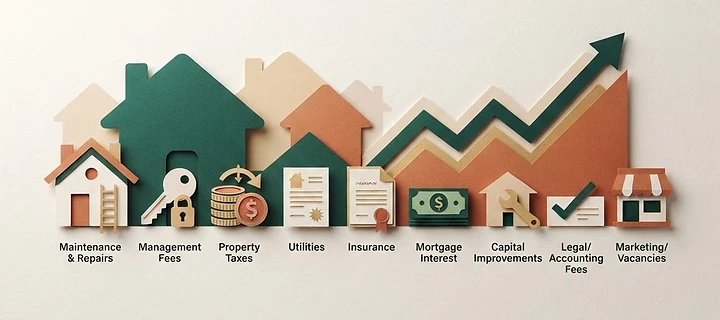
Accurate underwriting requires accounting for all rental property expenses, not just the mortgage payment. To properly estimate your true cash flow, you must subtract maintenance, capital expenditures (CapEx), property management, insurance, property taxes, vacancy losses, and utilities from your total rental income. Ignoring these hidden costs is the most common reason small investors fail to achieve their projected returns.
Understanding Essential Rental Property Expenses
When evaluating a new property, new investors often focus heavily on the mortgage principal and interest while overlooking the operational "leaks" in their budget. A rental property is a business, and like any business, it incurs costs regardless of whether a unit is occupied.
The Recurring Operating Costs
These are the bills that arrive like clockwork. Taxes and insurance are often escrowed, but they represent a significant percentage of your gross rental income. Property taxes vary wildly by state and county, and you can often find local tax assessment trends by reviewing data from the Census ACS. Insurance, meanwhile, is climbing in many U.S. markets; never use the seller's current policy as your future estimate. Instead, call local providers for quotes based on the actual asset value.
Maintenance vs. Capital Expenditures
This is where most investors miscalculate. Maintenance covers day-to-day items like a leaky faucet or a broken cabinet door. CapEx refers to the "big ticket" items with long lifespans—roofs, HVAC systems, and water heaters. A common rule of thumb is to set aside 5-10% of gross rents for maintenance and another 5-10% for CapEx. If you do not account for these, you are essentially borrowing against your property’s future health.
Vacancy and Property Management
Even if you plan to self-manage, you should underwrite for a professional property manager's fee, typically 8-10% of monthly rent. This provides you with an "exit strategy" for your time. Similarly, vacancy is inevitable. Depending on the local market, you should expect to lose at least one month of rent annually per unit. You can browse city rental market reports to see how average rents compare to local trends, which helps you estimate if a market is prone to higher turnover.
A Worked Example: Running the Numbers
Let’s assume you are looking at a single-family home with a monthly rent of $2,000.
- Gross Annual Income: $24,000
- Property Taxes: $3,000 (12.5%)
- Insurance: $1,200 (5%)
- Property Management (10%): $2,400
- Vacancy (8%): $1,920
- Maintenance (5%): $1,200
- CapEx (5%): $1,200
- Total Annual Expenses: $10,920
In this example, your operating expense ratio is roughly 45%. This means for every dollar you collect, you are spending 45 cents just to keep the lights on and the property maintained, before your mortgage is even paid. Using Areal to run a free ZIP analysis can help you verify if these expense ratios align with the historical norms for your target neighborhood.
How to Check Your ZIP Code Trends
Local data is the best antidote to speculative investing. Rather than guessing, use public resources to anchor your numbers. HUD Fair Market Rent data can tell you what the local ceiling for rent is, while Census ACS data provides insights into median household income in your area, which acts as a proxy for tenant affordability. By combining these sources, you can build a conservative pro-forma that accounts for the specific economic reality of your chosen ZIP code.
Frequently asked questions
What is a good operating expense ratio for a rental property?
A healthy operating expense ratio for a typical residential rental property is usually between 35% and 50% of gross income. Properties that require heavy maintenance or those in high-tax jurisdictions will lean toward the higher end of this range.
Should I include mortgage payments in my rental property expenses?
Strictly speaking, mortgage principal and interest are considered financing costs rather than operating expenses. When calculating Net Operating Income (NOI), you exclude the mortgage to evaluate the property's performance, then subtract the debt service afterward to find your actual cash flow.
How often should I re-evaluate my expense estimates?
You should revisit your expense estimates at least annually or whenever you face a lease renewal. Insurance premiums, local tax assessments, and utility costs change, so your underwriting model should be a living document rather than a one-time calculation.
Does Areal help calculate these expenses for me?
Yes, Areal allows you to model rental cash flow by integrating public datasets to help you see how local taxes, rents, and market conditions impact your bottom line. You can run a free ZIP analysis to get a clear picture of the specific rental economics in any U.S. market.
Put the method to work
Run a free ZIP-level market screen on Areal — home value and rent trends, HUD fair market rent, county income, crime, and an estimated cash flow, with every source shown.
Run a free analysis