
The Rent to Income Ratio: Is the 30% Rule Still Realistic in 2026?
Understanding your rent to income ratio is essential for financial health. Learn how to calculate it and why the 30% rule may need adjustment in 2026.
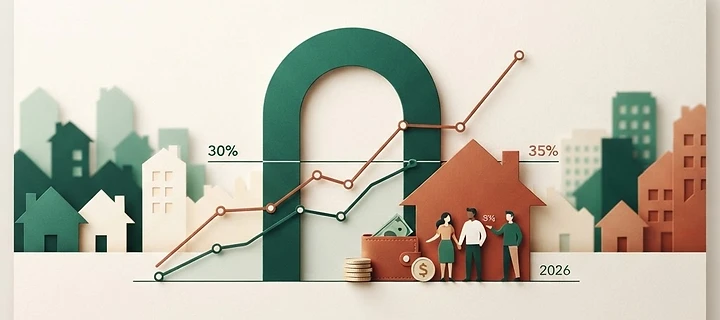
A healthy rent to income ratio is generally considered to be 30% or less of your gross monthly earnings, which leaves sufficient room for other living expenses and savings. However, in many high-cost U.S. metropolitan areas, this guideline often becomes difficult to maintain, requiring renters to balance housing costs against commuting expenses and lifestyle priorities.
The classic 30% rent to income ratio rule
For decades, the standard advice for renters has been to spend no more than 30% of their gross monthly income on housing. This metric stems from long-standing federal housing standards, including those referenced by the Department of Housing and Urban Development (HUD) when determining affordability benchmarks. The logic is straightforward: by capping rent at this level, households theoretically maintain enough "residual income" to cover food, transportation, healthcare, and debt payments without falling into financial distress.
While this "30% rule" remains a useful starting point, it is an imperfect measure. It does not account for localized cost-of-living variables. For instance, a renter in a city with excellent public transit might afford a higher rent than someone in a car-dependent region, as the latter faces significant "hidden" housing costs related to vehicle maintenance and fuel. To get a clearer picture of your specific financial situation, you can run a free ZIP analysis to see how local rent trends align with broader economic indicators.
How to calculate your rent to income ratio
Calculating your ratio is a simple exercise that requires only two numbers: your total gross monthly income and your proposed or current monthly rent.
The formula
(Monthly Rent / Gross Monthly Income) x 100 = Rent to Income Ratio
A practical example
Imagine you are considering an apartment in a competitive market.
- Your gross annual salary is $72,000.
- Divide by 12 months, and your gross monthly income is $6,000.
- The apartment you want is listed at $1,800 per month.
- ($1,800 / $6,000) = 0.30.
- Your ratio is exactly 30%, putting you right at the recommended threshold.
If that same apartment cost $2,100, your ratio would climb to 35%. While 35% might feel manageable if you have no student loans or credit card debt, it represents a deviation from the traditional guideline that warrants a careful look at your monthly budget.
Why the 30% rule breaks down in expensive metros
In many of the country's densest urban cores, rent prices have decoupled from local income growth as measured by the Census ACS. In these areas, finding an apartment at 30% of gross income can sometimes mean settling for an unsafe neighborhood or a significantly longer commute.
This is where the "50/30/20" budgeting framework offers a more modern alternative. Instead of focusing solely on rent, this approach suggests allocating 50% of your net income (after taxes) to all "needs"—which includes rent, utilities, groceries, and insurance. The remaining 30% goes to "wants" (entertainment, dining out), and 20% goes to savings or debt repayment. If rent consumes 40% of your net income, you might choose to cut your "wants" category to 20% to keep your overall financial health intact. For those researching specific markets, you can browse city rental market reports to see how various ZIP codes compare in terms of affordability and median income.
Verifying affordability in your specific area
National averages are helpful for context, but they rarely apply to your specific street or ZIP code. Markets are hyper-local. For example, the Houston rental market may present entirely different affordability dynamics than a coastal city in California.
When evaluating a new lease, use Areal to compare the asking rent against the local median household income provided by public census data. If the asking price for a property is significantly higher than the neighborhood average, you are not just paying for a roof; you are paying a premium for that specific location or amenity set.
Frequently asked questions
Does the rent to income ratio use gross or net income?
Most financial experts and landlords use gross income—the amount you earn before taxes and deductions—when calculating the 30% rent to income ratio. Using gross income provides a consistent baseline, though you should always consider your actual take-home pay when creating your personal budget.
What happens if I spend more than 30% on rent?
Spending more than 30% of your income on rent classifies you as "cost-burdened," which can make it harder to save for emergencies or pay down debt. While it is sometimes necessary in expensive cities, you should aim to offset the higher rent by reducing other variable expenses like transportation or subscription services.
Will landlords reject me if my ratio is higher than 30%?
Many landlords have strict income requirements, often insisting that your gross monthly income is at least 3 times the monthly rent, which is equivalent to a 33.3% rent to income ratio. If your ratio exceeds their threshold, they may require a co-signer or a larger security deposit to mitigate their risk.
How can I lower my rent to income ratio without moving?
To effectively lower your ratio, you must either increase your income or decrease your housing costs. Practical steps include seeking a roommate to split utility and rent costs or negotiating your lease renewal if local market data suggests that rents in your area have leveled off or declined.
Put the method to work
Run a free ZIP-level market screen on Areal — home value and rent trends, HUD fair market rent, county income, crime, and an estimated cash flow, with every source shown.
Run a free analysis