
Duplex vs Single-Family Rental: Which Performs Better for ROI?
Choosing between a duplex vs single-family rental involves trade-offs in vacancy, financing, and cash flow. Learn how to analyze your local market with Areal.
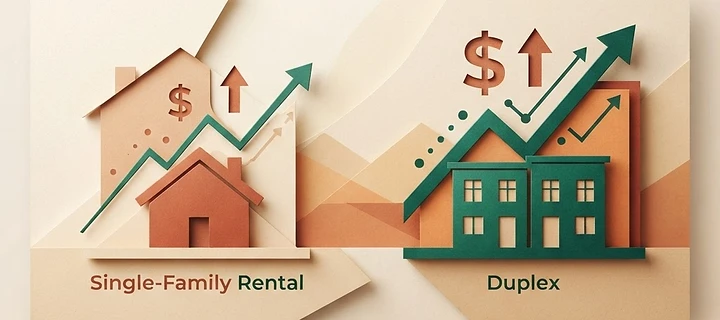
A duplex typically provides superior cash flow and lower vacancy risk due to income diversification, while a single-family rental often offers easier management and higher appreciation potential. Choosing between a duplex vs single-family rental depends on your specific goals regarding leverage, time commitment, and the local housing demand metrics found in datasets like the Census ACS or HUD Fair Market Rent.
Financing and Leverage Strategies
For most individual investors, financing is the primary constraint. Single-family homes are generally easier to finance using conventional 30-year fixed-rate mortgages, often with lower down payment requirements. Because these properties are categorized as residential real estate, they qualify for standard owner-occupied or investment loans.
Duplexes fall under the small-multifamily umbrella. If you reside in one unit (house hacking), you may still access conventional residential financing. However, purchasing a duplex as a pure investment property often triggers commercial or portfolio loan requirements, which may come with shorter amortization periods or adjustable-rate terms. Before choosing an asset, run a free ZIP analysis to determine if the local FHFA state home-price index trends justify the potential difference in financing costs.
Comparing Vacancy Risk and Revenue
Vacancy risk is the silent killer of rental returns. In a single-family rental (SFR), a tenant leaving means 100% loss of rental income until the property is re-leased. In a duplex, vacancy is isolated to one unit, providing a safety net of 50% income coverage while you manage turnover or repairs in the empty side.
The Math: A Simple Example
Let’s compare two hypothetical properties in a growing suburban area to see how the numbers shift.
-
Example Single-Family Rental: Purchased at $300,000. Rent is $2,200. Operating expenses (taxes, insurance, maintenance) are $800. Net operating income (NOI) is $1,400. If vacant for two months, you lose $4,400 in gross revenue and must cover the $800 fixed expense out-of-pocket for two months.
-
Example Duplex: Purchased at $450,000. Each unit rents for $1,400 (Total $2,800). Operating expenses are $1,200. NOI is $1,600. If one unit stays vacant for two months, you lose $2,800 in gross revenue, but the second unit still covers the $1,200 expense and contributes $200 toward your bottom line, keeping you cash-flow positive.
Management Complexity and Tenant Quality
SFR tenants often view the home as a long-term residence, leading to longer tenancies and lower turnover costs. Because the tenant is responsible for a single space, they are often more inclined to maintain the property. Conversely, duplex living creates shared boundaries. Noise complaints, parking disputes, and shared utility management between neighbors can increase the day-to-day "landlording" burden. When evaluating a potential investment, browse city rental market reports to see if local demand favors single-family stability or multifamily efficiency.
How to Assess Your Local Market
To decide which asset class wins in your area, you must look beyond intuition. Start by checking HUD Fair Market Rent data to see the ceiling for rental income in your target ZIP code. Compare this against the median household income found in the Census ACS. If a ZIP code shows a wide gap between rental costs and median income, you may face higher eviction risks or slower rent growth regardless of the property type.
Use the Areal blog as a resource to sharpen your underwriting skills. When looking at a specific street or neighborhood, look at FBI crime data or FHFA home price growth to ensure your exit strategy isn't hampered by long-term neighborhood stagnation. You can use Areal to pull these specific data points for any ZIP code, ensuring your decision is based on public data rather than neighborhood hearsay.
Exit Strategies and Liquidity
Single-family homes are highly liquid assets because the primary buyer pool includes both investors and owner-occupants. This broad market ensures that you can usually exit a position relatively quickly. Duplexes are more niche. Your buyer pool is primarily limited to other investors. If the market cools, liquidity for small multifamily properties can dry up faster than for standard residential homes.
Frequently asked questions
Does a duplex always offer higher cash flow than a single-family home?
Not necessarily. While a duplex mitigates vacancy risk, higher maintenance, management intensity, and potential for shared utility disputes can erode margins if the property is not managed efficiently.
Which property type appreciates faster?
Historically, single-family homes in desirable school districts tend to see higher appreciation because they appeal to a larger pool of owner-occupants, whereas duplexes are valued primarily based on their income-generating capacity.
How do I check if a neighborhood supports a duplex investment?
You should verify the rent-to-income ratio using Census ACS data and check for localized demand trends by looking at recent rental volume growth in that specific ZIP code via Areal.
Are maintenance costs higher for a duplex?
Often, yes. You are managing two sets of appliances, two potential HVAC systems, and higher foot traffic, which typically leads to more frequent wear and tear compared to a single-family home.
Put the method to work
Run a free ZIP-level market screen on Areal — home value and rent trends, HUD fair market rent, county income, crime, and an estimated cash flow, with every source shown.
Run a free analysis